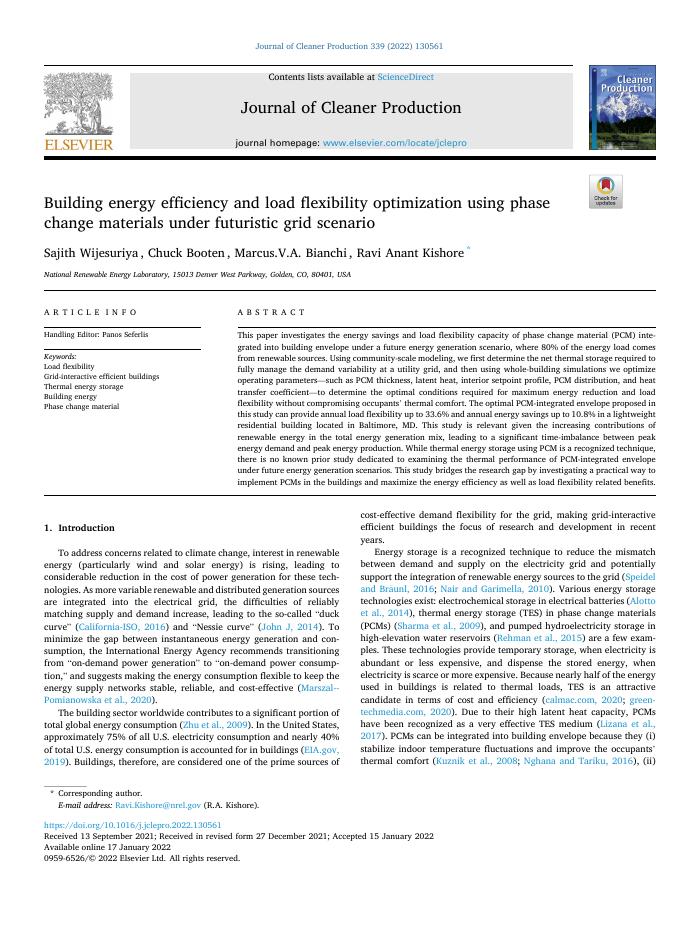
Building energy efficiency and load flexibility optimization using phase change materials under futuristic grid scenario
Penulis
Penerbit
Elsevier
Bahasa
Indonesia
Dilihat
1,326 kali
Ditambahkan
04 Apr 2022
Kategori
Sinopsis
This paper investigates the energy savings and load flexibility capacity of phase change material (PCM) integrated into building envelope under a future energy generation scenario, where 80% of the energy load comes from renewable sources. Using community-scale modeling, we first determine the net thermal storage required to fully manage the demand variability at a utility grid, and then using whole-building simulations we optimize operating parameters—such as PCM thickness, latent heat, interior setpoint profile, PCM distribution, and heat transfer coefficient—to determine the optimal conditions required for maximum energy reduction and load flexibility without compromising occupants’ thermal comfort. The optimal PCM-integrated envelope proposed in this study can provide annual load flexibility up to 33.6% and annual energy savings up to 10.8% in a lightweight residential building located in Baltimore, MD. This study is relevant given the increasing contributions of renewable energy in the total energy generation mix, leading to a significant time-imbalance between peak energy demand and peak energy production. While thermal energy storage using PCM is a recognized technique, there is no known prior study dedicated to examining the thermal performance of PCM-integrated envelope under future energy generation scenarios. This study bridges the research gap by investigating a practical way to implement PCMs in the buildings and maximize the energy efficiency as well as load flexibility related benefits.
Ulasan Pembaca
Masuk untuk memberikan ulasan dan rating.
Belum ada ulasan. Jadilah yang pertama!
Buku Terkait