Combining a hybrid prediction strategy and a mutation strategy for dynamic multiobjective optimization
Penulis
Penerbit
Elsevier
ISBN
2210-6502
Bahasa
Indonesia
Dilihat
1,156 kali
Ditambahkan
04 Apr 2022
Kategori
Sinopsis
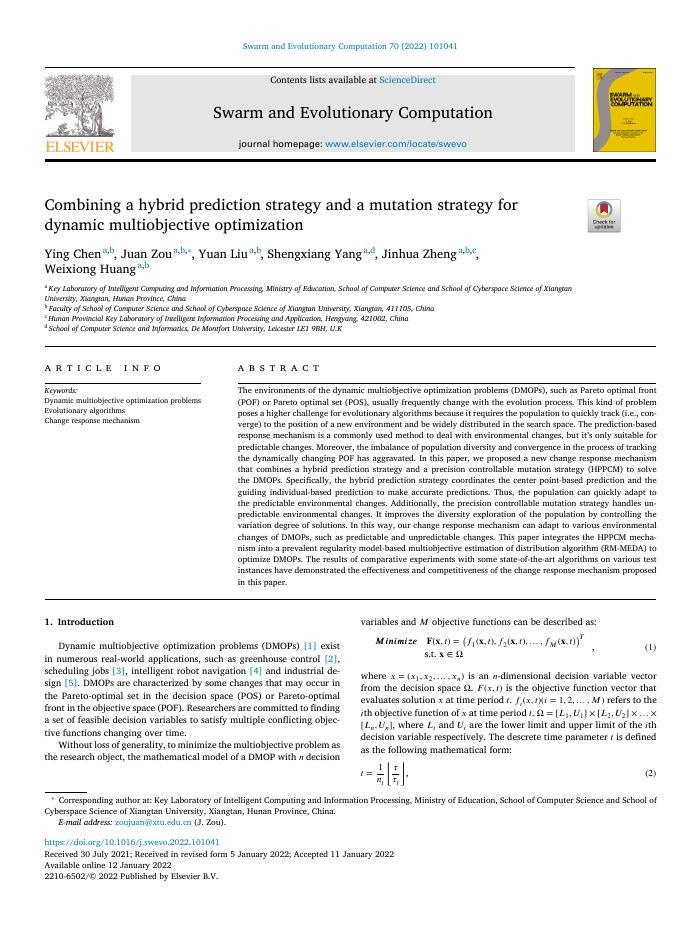
The environments of the dynamic multiobjective optimization problems (DMOPs), such as Pareto optimal front(POF) or Pareto optimal set (POS), usually frequently change with the evolution process. This kind of problem poses a higher challenge for evolutionary algorithms because it requires the population to quickly track (i.e., converge) to the position of a new environment and be widely distributed in the search space. The prediction-based response mechanism is a commonly used method to deal with environmental changes, but it’s only suitable for predictable changes. Moreover, the imbalance of population diversity and convergence in the process of tracking the dynamically changing POF has aggravated. In this paper, we proposed a new change response mechanism that combines a hybrid prediction strategy and a precision controllable mutation strategy (HPPCM) to solve the DMOPs. Specifically, the hybrid prediction strategy coordinates the center point-based prediction and the guiding individual-based prediction to make accurate predictions. Thus, the population can quickly adapt to the predictable environmental changes. Additionally, the precision controllable mutation strategy handles unpredictable environmental changes. It improves the diversity exploration of the population by controlling the variation degree of solutions. In this way, our change response mechanism can adapt to various environmental changes of DMOPs, such as predictable and unpredictable changes. This paper integrates the HPPCM mechanism into a prevalent regularity model-based multiobjective estimation of distribution algorithm (RM-MEDA) to optimize DMOPs. The results of comparative experiments with some state-of-the-art algorithms on various test instances have demonstrated the effectiveness and competitiveness of the change response mechanism proposed in this paper.
Ulasan Pembaca
Masuk untuk memberikan ulasan dan rating.
Belum ada ulasan. Jadilah yang pertama!
Buku Terkait