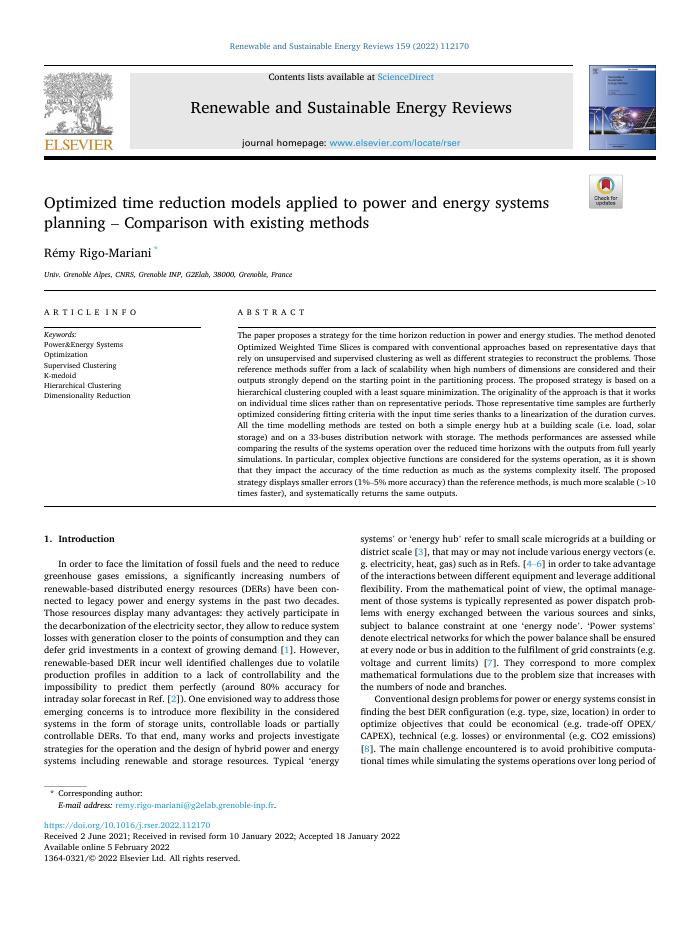
Optimized time reduction models applied to power and energy systems planning – Comparison with existing methods
Penulis
Penerbit
Elsevier
Bahasa
Indonesia
Dilihat
1,385 kali
Ditambahkan
04 Apr 2022
Kategori
Sinopsis
The paper proposes a strategy for the time horizon reduction in power and energy studies. The method denoted Optimized Weighted Time Slices is compared with conventional approaches based on representative days that rely on unsupervised and supervised clustering as well as different strategies to reconstruct the problems. Those reference methods suffer from a lack of scalability when high numbers of dimensions are considered and their outputs strongly depend on the starting point in the partitioning process. The proposed strategy is based on a hierarchical clustering coupled with a least square minimization. The originality of the approach is that it works on individual time slices rather than on representative periods. Those representative time samples are furtherly optimized considering fitting criteria with the input time series thanks to a linearization of the duration curves. All the time modelling methods are tested on both a simple energy hub at a building scale (i.e. load, solar storage) and on a 33-buses distribution network with storage. The methods performances are assessed while comparing the results of the systems operation over the reduced time horizons with the outputs from full yearly simulations. In particular, complex objective functions are considered for the systems operation, as it is shown that they impact the accuracy of the time reduction as much as the systems complexity itself. The proposed strategy displays smaller errors (1%–5% more accuracy) than the reference methods, is much more scalable (>10 times faster), and systematically returns the same outputs.
Ulasan Pembaca
Masuk untuk memberikan ulasan dan rating.
Belum ada ulasan. Jadilah yang pertama!
Buku Terkait