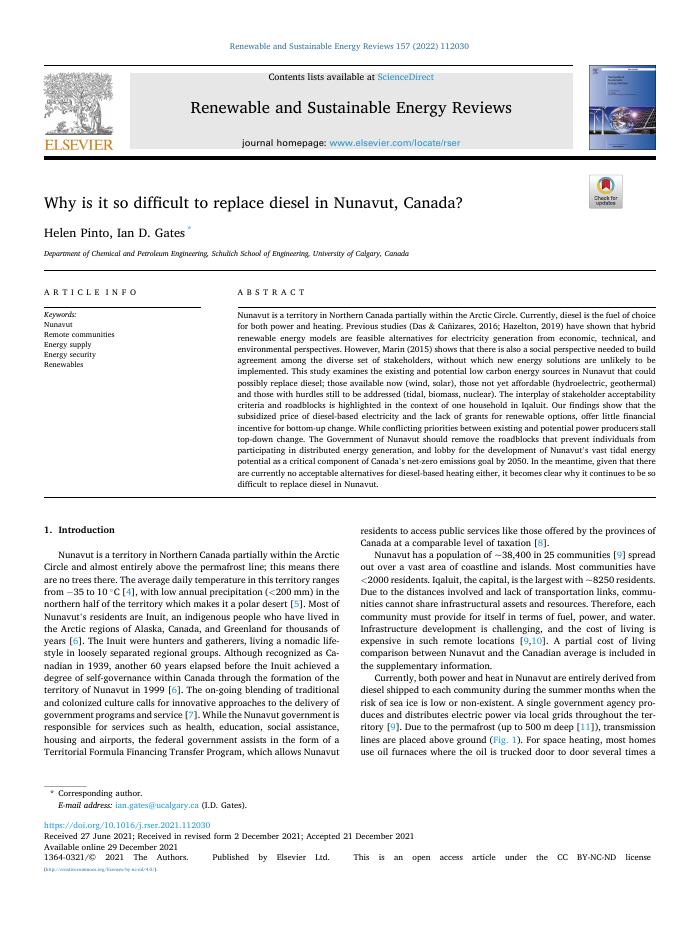
Why is it so difficult to replace diesel in Nunavut, Canada?
Kategori
Sinopsis
Nunavut is a territory in Northern Canada partially within the Arctic Circle. Currently, diesel is the fuel of choice for both power and heating. Previous studies (Das & Canizares, ˜ 2016; Hazelton, 2019) have shown that hybrid renewable energy models are feasible alternatives for electricity generation from economic, technical, and environmental perspectives. However, Marin (2015) shows that there is also a social perspective needed to build agreement among the diverse set of stakeholders, without which new energy solutions are unlikely to be implemented. This study examines the existing and potential low carbon energy sources in Nunavut that could possibly replace diesel; those available now (wind, solar), those not yet affordable (hydroelectric, geothermal) and those with hurdles still to be addressed (tidal, biomass, nuclear). The interplay of stakeholder acceptability criteria and roadblocks is highlighted in the context of one household in Iqaluit. Our findings show that the subsidized price of diesel-based electricity and the lack of grants for renewable options, offer little financial incentive for bottom-up change. While conflicting priorities between existing and potential power producers stall top-down change. The Government of Nunavut should remove the roadblocks that prevent individuals from participating in distributed energy generation, and lobby for the development of Nunavut’s vast tidal energy potential as a critical component of Canada’s net-zero emissions goal by 2050. In the meantime, given that there are currently no acceptable alternatives for diesel-based heating either, it becomes clear why it continues to be so difficult to replace diesel in Nunavut.
Ulasan Pembaca
Masuk untuk memberikan ulasan dan rating.
Belum ada ulasan. Jadilah yang pertama!
Buku Terkait